
ARFC-1022: Objective-Based Achievement, Assessment Policies, Aggregation, and Learner Progress
Status
| Draft | Draft Date: 2026-10-20 | Version: 0.2 |
Abstract
Learning objectives establish what students are expected to know, reason about, and do. Objectives originate from authority-based standards, instructor-defined expectations, or both. The system classifies objectives as knowledge, reasoning, or performance, providing a concise framework for describing the learning sought. Challenges give students opportunities to demonstrate proficiency against those objectives and provide the evidence on which assessment rests.
This ARFC defines how learners, instructors, and administrators interpret that evidence to understand achievement and progress. It distinguishes participation from demonstrated achievement and supports multiple assessment methods, including percentage mappings, objective-linked rubrics, and specified demonstrations. Every achievement judgment is made against an objective.
Assessed achievement is expressed through five levels: inevident, emerging, developing, proficient, and exemplary. An objective that has not been assessed is presented as unassessed, distinct from every achievement level. Attempting work does not, by itself, establish achievement, and an absence of assessment does not establish a lack of proficiency.
The goal is comprehensive transparency: making clear what has been assessed, what the evidence demonstrates, how each judgment was reached, and what remains unassessed or unmet. Achievement profiles preserve these distinctions across objectives and learning areas, while traditional percentage grades remain supported alongside them. Summary values identify their scope and assessment method so that strong performance in one area cannot conceal gaps in another. The Proficiency Achievement Profile visualizes demonstrated achievement, while the Proficiency Target Compass highlights the remaining achievement range to proficiency.
Table of Contents
- Introduction
- Motivation
- Specification
- Version 1 Scope
- Security Considerations
- Backward Compatibility
- References
- Author
- Revision History
1. Introduction
Students need to understand what they have learned and what they should work on next. Instructors need to identify the objectives for which a student needs further instruction, practice, or assessment. Administrators need to understand achievement across the curriculum while meeting institutional reporting requirements. These needs depend on a shared distinction: completing an activity records participation; demonstrating the intended learning establishes achievement.
A single course percentage cannot preserve every distinction these readers need. A student who earns 100 percent on the first half of a course and 40 percent on an equally weighted second half receives an average of 70 percent. An institution may require that figure and may designate it as passing, but the average does not establish proficiency in the objectives assessed during the second half. The platform must make those differences visible alongside any required summary grade.
Learning objectives provide the reference for interpreting achievement. As established in ARFC-1011: Learning Objectives and Challenge Alignment, objectives belong to a course and may be derived from authority-based standards or added by an authorized instructor. This proposal classifies objectives as knowledge, reasoning, or performance. These classifications describe the learning sought; the five achievement levels describe the student’s demonstrated achievement against it. Neither a lesson’s completion nor its aggregate score can substitute for assessing its objectives.
Challenges provide opportunities to produce evidence relevant to those objectives. One challenge may provide evidence for several objectives, and evidence for one objective may accumulate across several challenges and lessons. An assessment policy defines how that evidence supports a judgment. It may use percentages calculated from relevant evidence, a rubric whose criteria describe achievement against the objective, or successful demonstrations on a specified set of challenges. The method and its requirements must be identifiable so that a reported level can be understood and explained.
The resulting achievement profile preserves the student’s assessed level for each objective and identifies objectives that remain unassessed. Learning-area and course summaries provide broader views of that profile. Participation measures, traditional grades, and achievement levels remain distinguishable within those views, while changes in assessed achievement make progress visible over time. Comprehensive transparency requires that readers can trace a summary to the objectives, evidence, and assessment criteria beneath it, without concealing gaps through aggregation.
This proposal builds on the separation of evidence and interpretation in ARFC-1010: Challenge Evidence and Scoring and the objective alignment model in ARFC-1011. It proposes revisions to ARFC-1012: Grading Policy and Rollup: supporting multiple objective-based assessment mechanisms, including percentage mappings and rubrics; distinguishing unassessed from inevident; and adopting exemplary as the highest achievement level. These are changes to the proposed assessment model, not claims that those capabilities are already available.
2. Motivation
Current State
The platform already records challenge attempts and scores, selects the attempt that counts toward a grade, and aggregates scores with required and optional work reported separately. Course objectives and challenge-to-objective alignment provide a foundation for interpreting that work against intended learning. These capabilities are documented in ARFC-1010 and ARFC-1011.
That foundation does not yet provide the full assessment and reporting model proposed here. The implementation notes dated 2026-10-15 identify objective coverage reporting as outstanding and the grading-policy and mastery proposals in ARFC-1012 as deferred. This proposal builds on the documented capabilities while revising and extending that assessment direction.
Traditional percentages remain necessary for institutions whose reporting requirements depend on them. They provide a useful summary under a stated grading policy, but cannot alone explain which objectives a student has achieved, where further learning is needed, or whether enough evidence exists to make a judgment.
Missing Capabilities
Participation does not establish achievement. An attempted challenge shows that a student engaged with an opportunity to learn or demonstrate learning. It does not, by itself, show that the objective was achieved. Likewise, an objective that has not been assessed must remain distinguishable from an assessment finding that achievement is inevident. Conflating these states can misdirect instruction and misrepresent the student.
Averages can conceal gaps. As the example in the introduction illustrates, a passing course average can coexist with substantial difficulty in later material. The same problem occurs across learning areas: strong results in one area can offset weak results in another without demonstrating the missing learning. A required percentage or pass designation must therefore be accompanied by an account of achievement against the objectives it summarizes.
Different objectives require different ways of interpreting evidence. A percentage of successful responses may be suitable evidence for one objective; another may require a rubric that evaluates reasoning or a specified set of successful performances. A single conversion rule cannot express every legitimate assessment approach. The five achievement levels need explicit, objective-linked criteria so that their meaning is understandable even when the assessment mechanisms differ.
Aggregation can discard the information needed for action. Lesson, category, learning-area, and course summaries are useful only when readers can understand their scope and inspect the objectives beneath them. A summary of assessed objectives alone can appear complete while leaving unassessed objectives invisible. Repeated assessment of a few objectives can also dominate a score without broadening the learning demonstrated. Readers need to see both the achievement profile and the extent of assessment.
A current result does not explain progress. Students and instructors need to recognize improvement, continuing difficulty, and objectives awaiting assessment. A change in a summary may reflect new learning, additional assessed objectives, or a changed assessment policy. Without that context, an increase or decrease can be mistaken for a change in the student’s achievement.
Design Goals
Make objectives the basis of every achievement judgment. Preserve their origin in authority-based standards, instructor expectations, or both, and distinguish knowledge, reasoning, and performance objectives from the achievement levels used to assess them.
Support multiple assessment mechanisms within a common achievement scale. Allow percentages derived from relevant evidence, objective-linked rubrics, and specified demonstrations to support judgments of inevident, emerging, developing, proficient, or exemplary. Present objectives without an assessment as unassessed.
Provide comprehensive transparency. Enable students, instructors, and administrators to trace a judgment to its objective, supporting evidence, assessment criteria, and applicable policy. Make gaps and limitations visible so that a summary does not imply more than the evidence demonstrates.
Preserve meaning through aggregation. Provide understandable summaries at lesson, category, learning-area, and course levels while retaining access to the underlying achievement profile. Identify the objectives included, the aggregation method, and the extent of assessment; keep unassessed objectives and unmet expectations visible.
Support institutional reporting and instructional decisions together. Retain traditional percentage grades where required, alongside objective-based achievement reporting. Keep participation, achievement, and progress distinguishable so that required reporting can coexist with useful guidance about what to learn, teach, or assess next.
Make progress interpretable over time. Show how demonstrated achievement develops and provide the context needed to distinguish changes in learning from changes in assessment coverage or policy.
3. Specification
This section specifies the proposed assessment and reporting behavior. “Must” identifies a requirement of this proposal; “may” identifies a supported choice governed by the applicable policy.
3.1 Core Principles
Achievement is objective-based. Every achievement judgment must identify the learning objective or defined set of objectives to which it applies. Participation, attempted work, completion, and achievement must remain distinguishable.
Evidence and interpretation are distinct. A challenge provides an opportunity to demonstrate learning. An assessment policy defines how relevant evidence supports a judgment. Changing the interpretation must not erase the work or the basis of a previous judgment.
Absence of assessment is not an achievement level. An objective without a supported assessment judgment must be reported as unassessed. It must not be assigned inevident or treated as zero achievement merely because no judgment is available.
Summaries must support comprehensive transparency. A summary must disclose its scope and method, preserve access to the underlying achievement profile, and make unassessed objectives and unmet expectations visible. Strong achievement in one area must not conceal gaps in another.
flowchart TB
    accTitle: From standards to demonstrated achievement
    accDescr: Authority standards and instructor objectives define knowledge, reasoning, and performance objectives. Aligned challenges produce evidence, interpreted against each objective using an assessment policy. Supported judgments have one of five achievement levels; unassessed is separate.
    authority["Authority standards<br/>Required expectations"]
    instructor["Instructor-defined objectives<br/>Additional expectations"]

    subgraph objectives["Objective map · each objective retains its source and explicit criteria"]
        direction LR
        knowledge["Knowledge<br/>What the learner knows"]
        reasoning["Reasoning<br/>How the learner thinks"]
        performance["Performance<br/>What the learner can do"]
    end

    authority -->|define| objectives
    instructor -->|extend| objectives
    objectives -->|many-to-many alignment| challenges["Aligned challenges<br/>Opportunities to demonstrate objectives"]
    challenges -->|learner demonstrations produce| evidence["Evidence<br/>Work, results, and observations"]
    objectives -->|objective and criteria| assessment
    evidence -->|interpreted using| assessment
    assessment["Assessment against each objective<br/>Percentage mapping · Objective-linked rubric · Specified demonstrations<br/>Applicable policy determines evidence sufficiency and level"]

    assessment -->|supported judgment| levels
    subgraph levels["Achievement level for each objective · one of five possible outcomes"]
        direction LR
        inevident["inevident"]
        emerging["emerging"]
        developing["developing"]
        proficient["proficient"]
        exemplary["exemplary"]
    end
    assessment -->|insufficient or pending assessment| unassessed["unassessed<br/>No supported judgment available"]

    classDef neutral fill:#EDF4FA,stroke:#326588,color:#142332;
    classDef inevidentStyle fill:#A6A6A6,stroke:#66717C,color:#142332;
    classDef emergingStyle fill:#E8C547,stroke:#66717C,color:#142332;
    classDef developingStyle fill:#A8C94A,stroke:#66717C,color:#142332;
    classDef proficientStyle fill:#46A24C,stroke:#66717C,color:#102510;
    classDef exemplaryStyle fill:#196435,stroke:#196435,color:#FFFFFF;
    classDef unassessedStyle fill:#EEEEEE,stroke:#66717C,stroke-dasharray:5 3,color:#142332;
    class authority,instructor,knowledge,reasoning,performance,challenges,evidence,assessment neutral;
    class inevident inevidentStyle;
    class emerging emergingStyle;
    class developing developingStyle;
    class proficient proficientStyle;
    class exemplary exemplaryStyle;
    class unassessed unassessedStyle;

%% Participation alone does not establish achievement.
%% Every achievement judgment is against an objective.
%% Mermaid uses a dashed outline for unassessed; the illustrated draft uses hatching.
Figure 1. From standards to demonstrated achievement. Authority standards and instructor-defined objectives establish the objective map. Aligned challenges produce evidence that an applicable policy interprets against each objective. Knowledge, reasoning, and performance classify objectives; they are not achievement levels. An objective without a supported judgment remains unassessed.
3.2 Primary Objects
Learning objective: a statement of what the learner is expected to know, reason about, or perform. Objectives originate from authority-based standards, authorized instructor expectations, or both.
Challenge and evidence: a challenge is a question or task through which a learner can demonstrate learning. Evidence comprises the relevant work, results, observations, feedback, and recorded assessment conditions used to interpret that demonstration.
Assessment policy: the criteria and rules for selecting and interpreting evidence against objectives, including the achievement descriptors and assessment mechanism that apply.
Achievement judgment: an assessed level for an objective, with its supporting evidence, applicable policy, and assessment context.
Achievement profile: the set of objective-level judgments and unassessed objectives within a stated scope. A learning area, topic, or unit groups objectives for instruction and reporting; its title alone is not an assessable objective.
Aggregation policy: the explicit method for deriving a broader summary from an achievement profile. An aggregation policy must state what its summary means and which objectives contribute.
3.3 Objectives and Demonstrations
Each objective must retain its source and be classified as knowledge, reasoning, or performance. These classifications describe the intended learning, not the learner’s achievement level. Authority requirements remain the minimum expectations; instructor-added objectives may extend them.
Challenges must be aligned to the objectives they can provide evidence for. One challenge may address several objectives, and one objective may be assessed through several challenges. A score for a challenge must not automatically establish the same achievement level for every aligned objective: the evidence must support each judgment under its applicable criteria.
Assessment must distinguish learning opportunities from demonstrations that satisfy a policy. Where assistance, repeated exposure, independence, or other assessment conditions affect a judgment, the policy must identify those conditions and the available evidence must support them. Conditions that were not observed or recorded must not be assumed.
3.4 Achievement Levels and the unassessed State
The common scale comprises five ordered achievement levels. The following descriptions establish their general meaning; objective-linked criteria must make them assessable in each context.
inevident: assessed evidence does not demonstrate the achievement described by the objective to the emerging standard. This is a judgment about the available assessed evidence, not a claim that the learner has no knowledge or ability.
emerging: assessed evidence demonstrates an initial or partial achievement of the objective, meeting the policy’s emerging criteria.
developing: assessed evidence demonstrates achievement beyond emerging, while specified requirements for proficient remain unmet.
proficient: assessed evidence meets the stated proficiency criteria for the objective.
exemplary: assessed evidence meets explicitly defined criteria beyond proficient, such as depth, transfer, precision, or independence where relevant to the objective. Exemplary must not be awarded solely for attempting additional work.
unassessed: no supported achievement judgment is available. This includes work awaiting assessment or evidence that is insufficient to assign a level under the policy. Where known, the reason must be available to the reader. An unassessed state must remain distinct from all five levels.
The levels are ordinal categories. Their order does not establish equal numerical distances between levels, and they must not be averaged as if they were numerical scores.
3.5 Assessment Policies and Mapping Mechanisms
The platform must support more than one mechanism for interpreting demonstrated learning. Within the authority available to them, instructors and administrators may select or define policies appropriate to the objectives and institutional requirements.
Percentage mappings. A policy may calculate a percentage from evidence relevant to an objective and map defined ranges to achievement levels. It must identify the evidence included, the calculation, any weighting, and the level boundaries. A percentage spanning unrelated objectives must not be reused as the achievement level of each constituent objective.
Objective-linked rubrics. A policy may use criteria and performance descriptors to determine achievement. The rubric must identify the objective assessed, the evidence required, and how its criteria lead to a level. Where several criteria contribute, the rule for combining them and any essential criteria must be explicit.
Specified demonstrations. A policy may require success on a stated set or qualifying subset of challenges that demonstrates an objective. It must identify the qualifying demonstrations, what constitutes success, and any requirements for repeated demonstration or particular assessment conditions.
A policy may combine these mechanisms, provided their roles and the decision rule are explicit. Different objectives may use different mechanisms while sharing the five-level vocabulary. A common label does not, by itself, establish that judgments made under different policies are directly comparable.
Each policy must state how repeated attempts and evidence from different dates are considered, what makes evidence sufficient for a judgment, and how conflicting evidence is handled. A first, best, or latest attempt rule for a traditional grade must not silently determine objective achievement.
Each judgment must make its objective, level, supporting evidence, applicable criteria and policy, and assessment date available to authorized readers. Policy changes must be identifiable; a recalculated judgment must remain distinguishable from an improvement established by new evidence.
3.6 Aggregation and Summary Values
Achievement may be summarized for a lesson, category, topic, unit, learning area, or course. Every summary must identify its objective set, reporting period or as-of date, and aggregation policy. Required and optional objectives must be distinguishable.
The platform must support summaries that preserve the distribution of achievement, including counts of objectives at each level and the count that remains unassessed. A statement such as “eight of twelve objectives are proficient or exemplary” must identify all twelve objectives in its scope; it must not silently exclude unassessed objectives from the denominator. If a report intentionally uses only assessed objectives, that restricted scope must be explicit.
A single summary achievement level may be assigned only under a declared aggregation policy. Such a policy may, for example, require every essential objective to meet a specified level, or require a stated distribution of achievement together with mandatory objective conditions. These are policy choices, not universal defaults. If no policy supports a single level, the system must present the profile without inventing one.
An aggregation policy must define how unassessed objectives affect the summary and what evidence is required before a summary level can be assigned. Where those requirements are not satisfied, the summary must remain unassessed and expose the available objective-level judgments. Where a summary is permitted despite gaps, those gaps and the rule permitting the summary must remain visible alongside it.
An objective may appear in several instructional groupings. A course-level count must count each distinct objective once unless a different counting basis is explicitly identified. Multiple challenges assessing the same objective must not be presented as additional objectives achieved.
Traditional numerical grades and institution-defined pass designations remain supported as separate summaries. Their calculation and thresholds must be identifiable. A passing grade does not, by itself, establish proficiency across the course objectives, and the platform must not impose a universal passing percentage.
3.7 Achievement Profiles and Progress over Time
The achievement profile must allow authorized learners, instructors, and administrators to identify objectives at each level, distinguish unassessed objectives, and inspect the evidence and criteria behind judgments. Broader views must preserve access to that detail.
Progress reporting must distinguish changes in demonstrated achievement from changes in assessment coverage, objective scope, or policy. Attempt counts, completion measures, and traditional grades may be presented alongside the profile, but must be labeled according to what they measure.
A current profile is an as-of view of achievement. A report describing progress over time must identify the comparison dates and any material changes to the objectives or policies that affect interpretation. Historical judgments and their original context must remain interpretable.
3.8 Proficiency Achievement Profile and Proficiency Target Compass
The Proficiency Achievement Profile and Proficiency Target Compass are complementary views of the same objective-level achievement profile. The Profile answers “What has the learner demonstrated?” The Compass answers “Where should the learner focus to reach proficiency?” Both must use the same scope, objectives, grouping, sector order, assessment judgments, and as-of date when presented together. Changing the view does not change any judgment or assessment policy.
3.8.1 Shared Geometry and Interpretation
Both views are hierarchical polar charts with an ordinal radial scale. A circular sector is a region bounded by two radii and the circular arc joining their endpoints. An annulus is the ring-shaped region between two concentric circles. An annular sector is a portion of that ring bounded by two concentric circular arcs and two radial line segments. The Profile uses center-out sector fills; the Compass uses annular sector fills to show the remaining range to proficiency.
Let R denote the radius of the data circle, excluding labeling arcs. Four concentric circular boundaries divide the radius into equal steps:
| Boundary | Radius | Achievement level |
|---|---|---|
| First from the center | R/4 | emerging |
| Second from the center | R/2 | developing |
| Third from the center | 3R/4 | proficient |
| Outermost | R | exemplary |
The region from the center to R/4 is a disk; the three successive regions are annular bands. All four circular boundaries and all sector dividers must remain visible over every fill in both views. The proficiency boundary may be emphasized. The outer exemplary band, from 3R/4 to R, remains present in both views, including when it is unshaded in the Compass.
Each sector corresponds to an objective or an explicitly defined aggregation of objectives. Peer sectors at the most detailed displayed level have equal angular width. Concentric labeling arcs outside the data circle identify the hierarchy: outer labeling arcs identify broader learning areas, and inner labeling arcs identify constituent topics or objectives. Each grouping arc spans its constituent sectors. Every sector must have an unambiguous label and connection to the objectives it represents.
The radial positions express ordered categories, not equal increments of learning. Angular width allocates display space; it does not establish importance, assessment weight, or amount of work. Neither filled area nor visual fullness constitutes a grade, completion percentage, estimate of effort, or determination of proficiency across the course. Sector area increases with the square of radius. A single chart is a snapshot; progress requires an identified comparison over time.
3.8.2 Proficiency Achievement Profile
The Proficiency Achievement Profile displays demonstrated achievement. For emerging through exemplary, a sector is filled continuously from the center to the boundary of its assessed level. The remaining region is white. Yellow progresses through yellow-green and green to dark green as demonstrated achievement increases.
| Assessed state | Treatment | Radial extent |
|---|---|---|
| emerging | Yellow, #E8C547 | Center to R/4 |
| developing | Yellow-green, #A8C94A | Center to R/2 |
| proficient | Green, #46A24C | Center to 3R/4 |
| exemplary | Dark green, #196435 | Center to R |
| inevident | Solid neutral gray, #A6A6A6 | Entire sector, center to R; categorical treatment only |
| unassessed | Neutral diagonal hatching on white | Entire sector, center to R; categorical treatment only |
Gray identifies inevident as an assessment finding; its full-sector extent does not represent exemplary achievement or any numerical amount of learning. Hatching identifies the absence of a supported judgment and must remain distinguishable from gray. These are state treatments outside the achievement color progression. The underlying achievement profile remains the set of judgments and unassessed objectives defined in Section 3.2; the capitalized Proficiency Achievement Profile names this graphical presentation of it.
3.8.3 Proficiency Target Compass
The Proficiency Target Compass highlights objectives that have not yet reached proficiency. Its target boundary is 3R/4. For emerging and developing, an annular sector is filled inward from that boundary to the learner’s current achievement boundary. Light blue indicates the smaller remaining range for developing; dark purple indicates the larger remaining range for emerging. Darker color therefore means a greater remaining achievement gap, while darker achievement colors in the Profile mean greater achievement.
| Assessed state | Treatment | Radial extent |
|---|---|---|
| developing | Light blue, #A8CEF0 | R/2 to 3R/4: one annular band, second from the outside |
| emerging | Dark purple, #572080 | R/4 to 3R/4: two annular bands, second and third from the outside |
| inevident | Solid neutral gray, #A6A6A6 | Center to 3R/4; categorical treatment only |
| proficient or exemplary | White | No remaining proficiency-gap fill |
| unassessed | Neutral diagonal hatching on white | Center to 3R/4; categorical treatment only |
The outer exemplary band, from 3R/4 to R, must always remain white in the Compass, including in inevident and unassessed sectors. It must not be removed, rescaled, or included in the remaining-gap coloration. The circular boundary at R/2 must remain visible through an emerging sector’s purple fill: emerging spans two bands, whereas developing spans one.
Proficient and exemplary both meet the Compass target, but their distinct assessed levels must remain available in the textual equivalent and underlying assessment detail. An unassessed sector calls for assessment or sufficient evidence; it must not be represented as an established learning gap. Gray for inevident remains an explicit exception to the blue-to-purple progression.
The Compass helps learners and instructors identify objectives needing attention. Its shading does not estimate time, task count, difficulty, or effort, and two bands do not imply twice the work of one band. It does not automatically prescribe instruction or a sequence of activities. Exemplary remains a supported achievement level in the Profile even though the Compass targets proficiency.
3.8.4 Evidence, Accessibility, and Reporting
Each reported level must be determined by an explicit assessment policy applied to relevant evidence. Where a sector aggregates objectives, its objective set and aggregation method must be identifiable. Its underlying achievement profile, including unassessed objectives and unmet conditions, must be accessible. A sector labeled only “Addition,” for example, is a topic summary unless a specific aligned objective has been identified. White in the Compass reports that the displayed sector’s target is met under its stated policy; it must not conceal unassessed objectives or unmet conditions within an aggregation.
Each view must provide its own legend and a textual equivalent identifying every sector and its assessed or unassessed state without relying on color. Legends must explain gray and hatching as categorical states. Grid boundaries must remain discernible against light and dark fills. In an interactive view, selecting a sector must expose its objectives, actual achievement or unassessed state, supporting evidence, assessment criteria, and policy. A static report must supply equivalent explanatory detail in accompanying content. Reports must identify scope and as-of date so that neither view implies more than the evidence supports.
3.9 Illustrative Achievement Profile and Target Compass
The following paired examples use the same twelve sectors under Integers, Fractions, and Decimals, each containing Addition, Subtraction, Multiplication, and Division. Their levels are illustrative and do not describe a real learner. Each topic sector stands for an objective or objective set that a live report would identify.
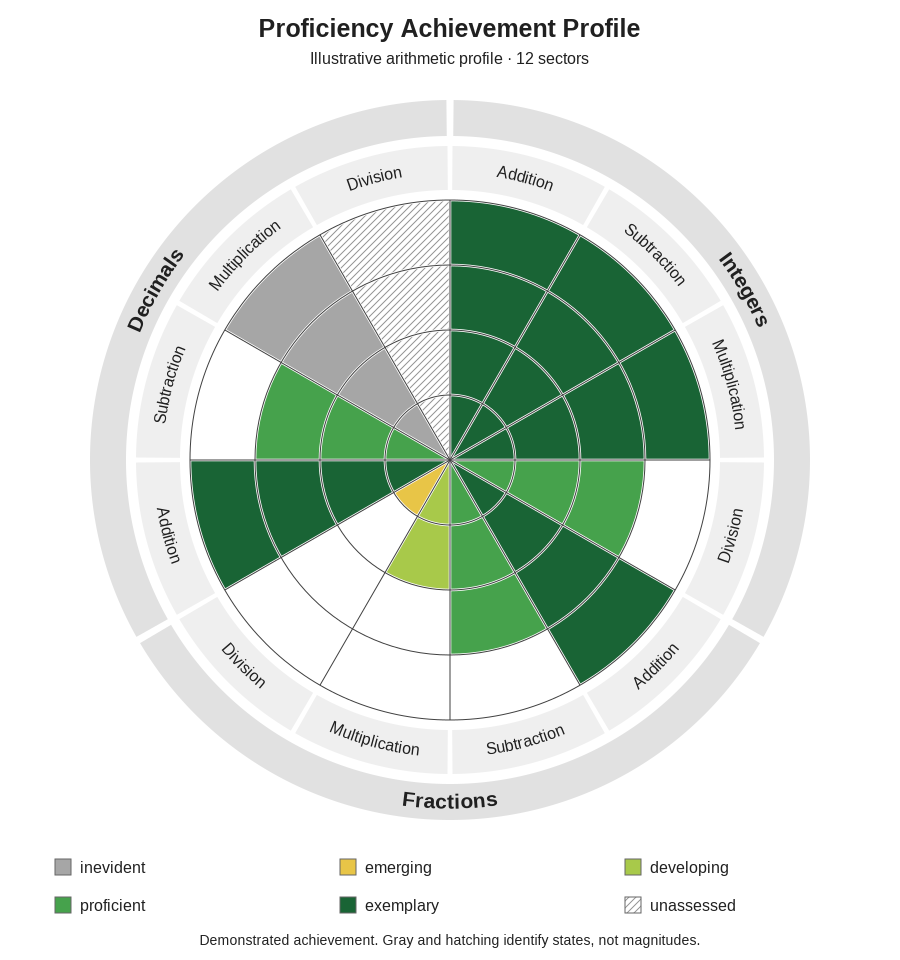
Figure 2. Proficiency Achievement Profile: demonstrated achievement extends outward toward exemplary. Gray and hatching identify categorical states, not achievement magnitudes.
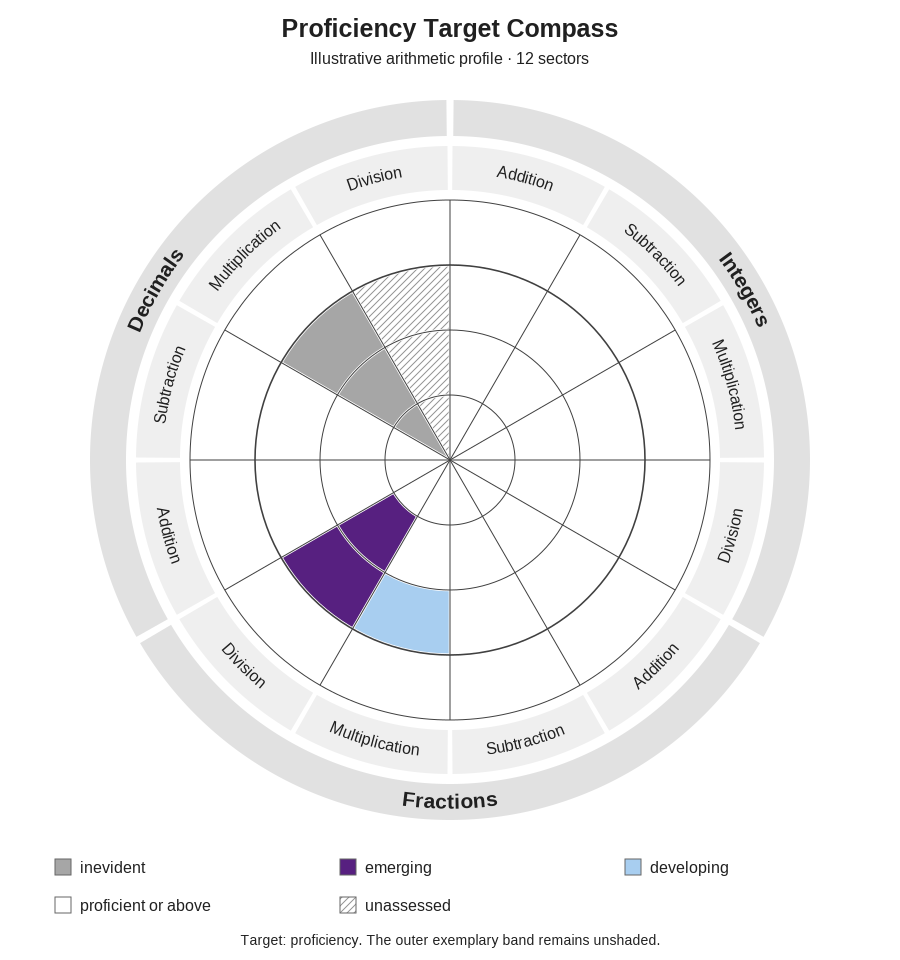
Figure 3. Proficiency Target Compass: the remaining range to proficiency extends inward from the third boundary. All four radial boundaries remain visible; the exemplary band is retained and unshaded.
The paired design illustration presents both views side by side. Figures 2 and 3 express the same design with exact, equally spaced radial boundaries; the design illustration is a visual reference rather than a scale drawing.
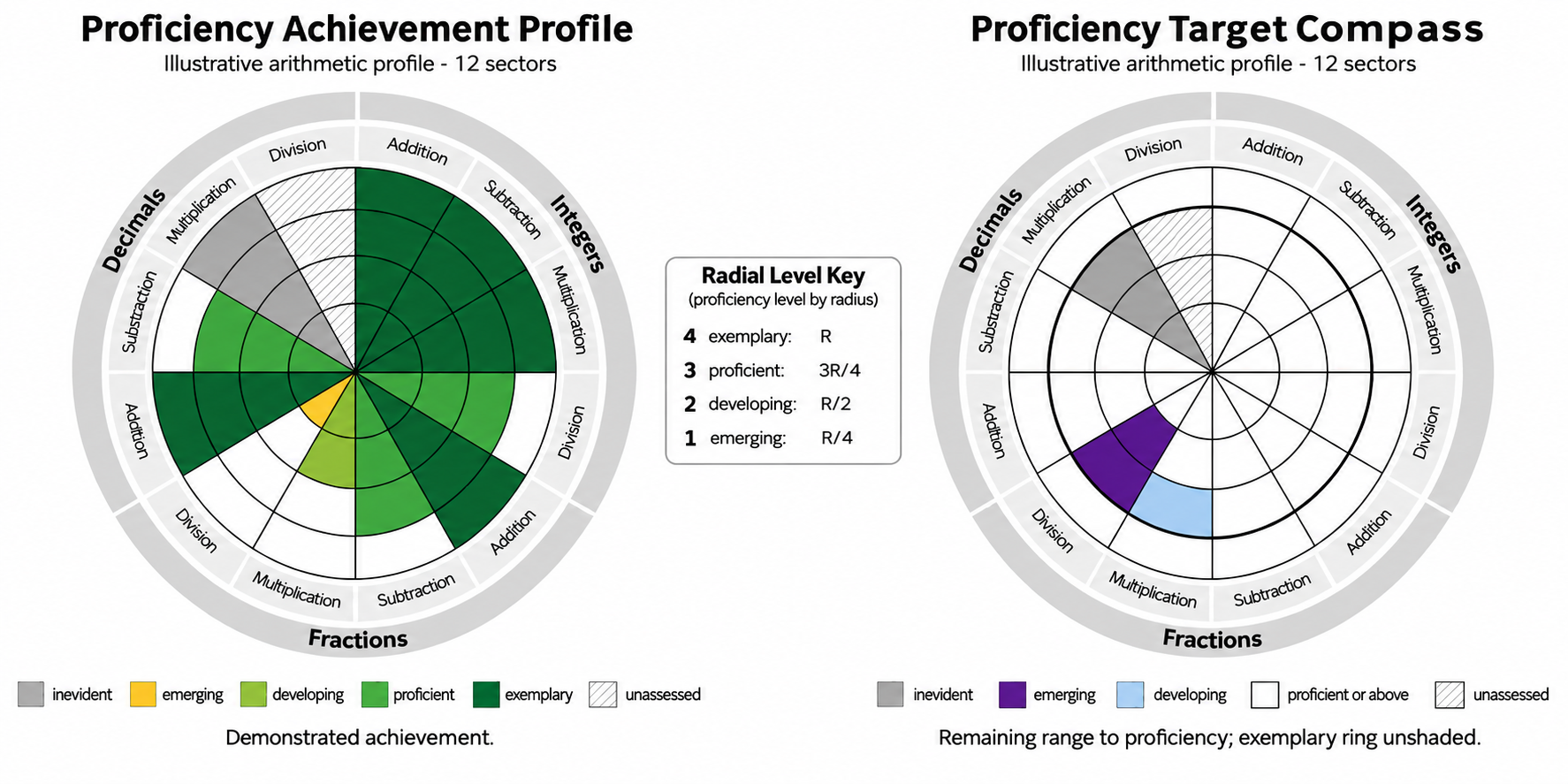
| Learning area | Topic | Assessed state | Achievement Profile | Target Compass |
|---|---|---|---|---|
| Integers | Addition | exemplary | Dark green to R | White; target met |
| Integers | Subtraction | exemplary | Dark green to R | White; target met |
| Integers | Multiplication | exemplary | Dark green to R | White; target met |
| Integers | Division | proficient | Green to 3R/4 | White; target met |
| Fractions | Addition | exemplary | Dark green to R | White; target met |
| Fractions | Subtraction | proficient | Green to 3R/4 | White; target met |
| Fractions | Multiplication | developing | Yellow-green to R/2 | Light blue, R/2 to 3R/4; one band |
| Fractions | Division | emerging | Yellow to R/4 | Dark purple, R/4 to 3R/4; two bands |
| Decimals | Addition | exemplary | Dark green to R | White; target met |
| Decimals | Subtraction | proficient | Green to 3R/4 | White; target met |
| Decimals | Multiplication | inevident | Gray to R; state treatment | Gray to 3R/4; state treatment |
| Decimals | Division | unassessed | Hatching to R; state treatment | Hatching to 3R/4; assessment needed |
Fraction Division’s purple annular sector spans two bands and extends one band farther inward than Fraction Multiplication’s light-blue annular sector. This shows a greater remaining achievement range, not a quantified difference in required work. Decimal Division’s hatching identifies a need for assessment, distinct from the assessed inevident finding for Decimal Multiplication.
The sample contains five exemplary sectors, three proficient, one developing, one emerging, one inevident, and one unassessed. Eight of the twelve displayed sectors are proficient or exemplary and therefore white in the Compass. This is a count of displayed sectors, not a percentage grade, an objective count for an unspecified aggregation, or a course-level achievement judgment. The remaining gaps remain visible despite strong achievement elsewhere.
4. Version 1 Scope
Version 1 establishes objective-based assessment and comprehensive transparency for an individual learner within a course. It includes the assessment mechanisms, aggregation rules, and reporting views needed to explain demonstrated achievement and progress. The requirements in Section 3 govern the capabilities included below.
Included
Objectives and evidence alignment. Retain the source of authority-based and instructor-defined objectives; classify objectives as knowledge, reasoning, or performance; and associate relevant challenge evidence with the objectives it can demonstrate. Support reporting groupings for lessons, categories, topics, units, learning areas, and the course.
Achievement judgments. Report inevident, emerging, developing, proficient, and exemplary against explicit objective-linked criteria. Represent objectives without a supported judgment as unassessed, with the reason available where known. Keep participation and completion measures distinct from achievement.
Multiple assessment mechanisms. Allow authorized instructors and administrators to select or define percentage mappings, objective-linked rubrics, and requirements for success on specified sets or qualifying subsets of challenges. Support explicit combinations of these mechanisms. Policies must explain evidence sufficiency, repeated attempts, conflicting evidence, and any assessment conditions that affect a judgment.
Transparent aggregation. Provide objective-level profiles and distributions of achievement for the supported reporting groupings. Identify the objectives included, distinguish required and optional objectives, and expose unassessed objectives and unmet expectations. Support a single summary level only when an explicit aggregation policy justifies it, including any mandatory objective conditions. Preserve traditional percentage grades and institution-defined pass designations alongside the profile.
Explanation and history. Allow authorized learners, instructors, and administrators to trace judgments and summaries to their objectives, evidence, criteria, policies, and assessment dates. Preserve the context of earlier judgments and provide comparisons between identified dates that distinguish changes in achievement from changes in assessment coverage, objective scope, or policy.
Proficiency Achievement Profile and Proficiency Target Compass. Provide both complementary views described in Section 3.8, using the same objective-level judgments and grouping. Include all four visible radial boundaries, grouped labeling arcs, the specified palettes and fill ranges, gray for inevident, neutral hatching for unassessed, legends, and textual equivalents. The Profile shows demonstrated achievement; the Compass highlights the remaining range to proficiency while retaining an unshaded exemplary band. Interactive and static reports must expose the underlying assessment information. Neither view estimates required effort or automatically prescribes instruction.
Excluded
Cross-course equivalence and population comparisons. Version 1 does not establish equivalence between objectives or policies from different courses or institutions, or provide cohort rankings, district-wide analytics, or comparisons of instructor effectiveness. Administrators may inspect authorized individual learner reports within the included scope.
Predictive assessment and instructional automation. Predicting future achievement, inferring proficiency from engagement alone, automatically recommending instruction, and adapting a learner’s course sequence are outside this version. They are not substitutes for the evidence and criteria required for a supported judgment.
New curriculum and assessment content. This proposal does not supply a complete standards catalog, subject-specific rubric library, or challenge bank. Version 1 supports the objectives, criteria, and demonstrations selected or authored by the responsible authorities and instructors.
External reporting integrations. Connections to district student information systems, external gradebooks, and jurisdiction-specific report formats are outside this version. Traditional numerical grades remain included; transmitting them to external systems is separate work.
A universal passing threshold, a universal conversion from course percentage to objective achievement, and averaging ordinal achievement levels are not deferred features. They are inconsistent with the assessment and transparency requirements of this proposal.
5. Security Considerations
Achievement profiles, challenge evidence, assessment feedback, and historical judgments contain learner information that must be protected. Comprehensive transparency requires an understandable account of each judgment for authorized readers. It does not grant unrestricted access to learner records, other learners’ work, or protected assessment materials.
Access to learner records. Access must be limited to the learners, courses, and institutional responsibilities for which a person is authorized. Learners may inspect their own reports and permitted supporting evidence; instructors and administrators may inspect records within their assigned responsibilities. The same restrictions must apply to objective-level details, summaries, charts, historical views, and exports. Access to a summary must not expose supporting records that the reader is not authorized to view, including another learner’s contribution to shared work.
Authority to assess and change policies. Permission to view a report must be distinct from permission to assess evidence, revise a judgment, change objective alignment, or define assessment and aggregation policies. Only authorized people may make those changes within their permitted scope. Instructor additions must not silently remove authority-based requirements or weaken required proficiency conditions. Learners must not be able to alter the evidence, criteria, or results used to assess them by editing a report or its presentation.
Integrity and accountability. Judgments must remain traceable to their evidence, objectives, applicable policy, assessment date, and responsible assessor or automated assessment process. Changes to evidence, alignment, criteria, policies, and judgments must record who or what made the change, when it occurred, and the stated reason where applicable. Corrections and recalculations must be distinguishable from the original judgment and from achievement established by new evidence. Audit records must themselves be protected against unauthorized access and alteration.
Assessment materials and learner contributions. Explanations must provide enough information to understand a judgment while respecting restrictions on answer keys, unreleased challenges, and third-party material. Where supporting material cannot be shown, the report must identify the restriction and provide an authorized explanation of the relevant criteria and result. Submitted work and attached material must be treated as evidence to assess; their contents must not authorize policy changes, access to other records, or actions outside the assessment.
Reports and exports. A chart or summary remains a learner record even when it omits raw responses. Shared and exported reports must contain only information permitted for the intended audience and must identify their scope, as-of date, and applicable assessment or aggregation policy. A static report must not appear to be a live or subsequently updated judgment. Textual alternatives and linked evidence must receive the same access protection as the visual report.
Retention and unavailable information. Evidence and assessment history must follow the platform’s applicable retention and deletion rules. Preserving an interpretable history does not justify indefinite retention of every learner submission. If evidence has been removed or is unavailable, authorized readers must be able to distinguish that condition from an assessment finding. Access failures, unavailable records, or incomplete calculations must not silently become inevident, zero achievement, or a newly assigned unassessed state.
6. Backward Compatibility
This proposal extends existing challenge evidence, objective alignment, and grading capabilities with objective-based achievement reporting. Adoption must preserve the meaning of existing records while making the additional assessment requirements explicit. Existing scores and completion records remain useful evidence, but do not automatically establish achievement against an objective.
Existing attempts and traditional grades. Recorded attempts, responses, scores, feedback, and completion status must remain available under the applicable access and retention rules. Existing numerical grades and institution-defined pass designations must retain their original grading context. Enabling achievement reporting must not silently change the attempt-selection rule, weighting, or passing threshold used for a traditional grade. Participation and completion measures must remain labeled according to what they measure.
Existing objectives and alignments. Course objectives and challenge-to-objective alignments may be reused after their suitability for assessment is established. Their sources, knowledge, reasoning, or performance classifications, and applicable achievement criteria must be available before they support the new judgments. A lesson title, topic label, or challenge score must not be substituted for a missing objective. Where alignment or criteria are incomplete, the report must disclose the limitation rather than imply complete assessment coverage.
Use of historical evidence. Historical work may support an achievement judgment when it can be associated with the relevant objective and satisfies an explicit assessment policy. Any retrospective interpretation must identify the evidence dates, the policy applied, and when the judgment was made. Assessment conditions that were not recorded must not be inferred. A course or lesson percentage must not be copied to each constituent objective, and a prior passing designation must not be treated as proof of proficiency across those objectives.
Missing judgments and earlier achievement scales. An objective without a supported judgment must be shown as unassessed. Migration must not assign inevident or zero achievement merely because an earlier system lacks objective-level assessment. If an earlier record uses different achievement labels, those labels and their original meanings must remain interpretable. Conversion to the five-level scale requires an explicit mapping justified by the objective-linked criteria; similarity of names or numerical positions alone is insufficient. Where no defensible mapping exists, the earlier result may remain visible alongside an unassessed objective under the new policy.
Adoption and report continuity. A course may continue to report traditional grades while its objectives and policies are prepared for achievement reporting. Reports must distinguish achievement reporting that is not yet configured from a configured objective that remains unassessed. When achievement reporting is introduced, its scope and effective date must be identified, and all objectives within that stated scope must remain visible, including those without judgments. Existing reports must not be silently relabeled as achievement profiles.
Historical comparisons and policy changes. Progress comparisons spanning adoption or a policy revision must disclose any change in objective scope, criteria, or interpretation. A newly calculated level must not be presented as improvement caused by new learning when it results from reinterpreting existing evidence. Earlier reports and judgments must retain enough context to explain what was reported at the time, subject to the retention and access requirements in Section 5.
7. References
Related ARFCs
Read each ARFC together with its implementation notes. Proposal text alone does not establish delivered behavior; the implementation notes dated 2026-10-15 inform the current-state discussion in this document.
-
ARFC-1010: Challenge Evidence and Scoring — Existing attempt selection and score rollup, and proposed extensions that make evidence more interpretable. Its implementation note distinguishes existing scoring behavior from deferred evidence capabilities.
-
ARFC-1011: Learning Objectives and Challenge Alignment — Course objectives, authority and instructor provenance, challenge alignment, and objective coverage. Provides the objective model on which this proposal builds; its implementation note identifies coverage reporting that remains outstanding.
-
ARFC-1012: Grading Policy and Rollup — Earlier proposals for interpreting evidence, grading policies, and mastery reporting. This ARFC revises that assessment direction through multiple mapping mechanisms, the five achievement levels, a distinct unassessed state, and transparent aggregation. The earlier policy and mastery capabilities remain deferred according to its implementation note.
-
ARFC-1013: Scope and Sequence Structure — Course plans, units, objective groupings, and lesson placements. Relevant to the instructional groupings used in achievement profiles and summaries.
-
ARFC-1014: Scope and Sequence Change Impact — The effects of changing plans, objectives, and lesson relationships. Relevant to preserving assessment context and interpreting progress when instructional scope changes.
Related Platform Documentation
-
Courses and Lessons — A reader-oriented account of how courses, scope and sequence, lessons, challenges, sections, assignments, and grades relate.
-
Content Models and Authoring — Documents content delivery, challenge attempts, evaluation, score weighting, attempt selection, and required/optional grade reporting. In particular, completion means graded rather than passed; the existing points model does not establish objective achievement.
8. Author
David Ben-Yaakov, M.Ed.
9. Revision History
| Version | Date | Change |
|---|---|---|
| 0.1 | 2026-10-20 | Initial draft with assessment and aggregation requirements, diagrams, Version 1 scope, security, backward compatibility, and references. |
| 0.2 | 2026-11-06 | Define shared polar-chart geometry, distinguish the Proficiency Achievement Profile and Proficiency Target Compass, specify palettes and state treatments, and add paired examples with exact radial boundaries. |